How Are Glucosylated Steviol Glycosides Produced?
Understanding the Science Behind Enzymatic Glucosylation
Article Summary
Glucosylated Steviol Glycosides (GSG) are produced by enzymatically attaching glucose units to naturally occurring steviol glycosides. This article explains the general production principle, why enzyme technology is used, and how glucosylation contributes to improved sweetness performance while maintaining the stevia-derived origin of the ingredient.
Introduction
The food and beverage industry continues to seek natural sweeteners that deliver better taste while supporting sugar reduction. Among recent innovations, Glucosylated Steviol Glycosides (GSG) have gained increasing attention because they combine the natural origin of stevia with an improved sensory profile.
Unlike conventional steviol glycosides, GSG undergoes an additional enzymatic modification step designed to optimize sweetness perception. This technology has become an important advancement in the development of next-generation stevia ingredients.
From Stevia Leaves to GSG
The production of GSG begins with steviol glycosides extracted from the leaves of Stevia rebaudiana Bertoni. These naturally occurring compounds, including Rebaudioside A (Reb A) and Stevioside, serve as the starting materials for enzymatic modification.
After extraction and purification, selected steviol glycosides undergo an enzymatic glucosylation process. During this step, food-grade enzymes transfer glucose units to the steviol glycoside molecules, creating glucosylated derivatives with modified sensory characteristics.
Finally, the product is purified, dried, and subjected to quality control before packaging.
Technical Process Diagram
Stevia Leaves
│
Extraction
│
Purification
│
High-Purity Steviol Glycosides
│
Enzymatic Glucosylation
│
Purification
│
Drying
│
Quality Control
│
Finished GSG
Illustration based on publicly available manufacturing principles. Individual production processes and proprietary technologies vary among manufacturers.
What Is Enzymatic Glucosylation?
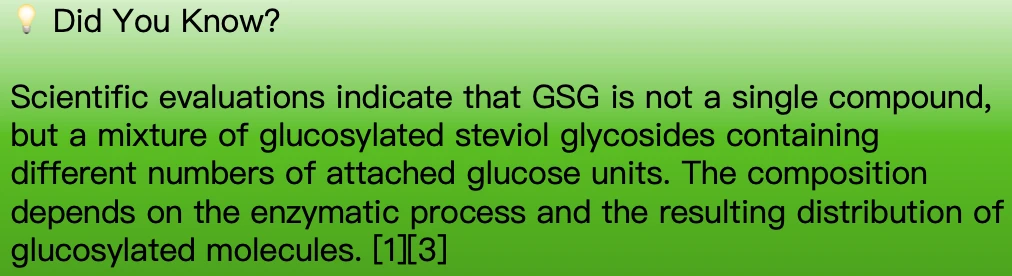
Enzymatic glucosylation is a biological process in which enzymes transfer glucose units to naturally occurring steviol glycosides. This modification alters the molecular structure sufficiently to influence sweetness perception while retaining the stevia-derived origin of the ingredient.
Unlike chemical synthesis, enzymatic modification is performed under controlled biological conditions and has become an important technology in the development of advanced stevia sweeteners.
Why Is Enzyme Technology Important?
The purpose of enzymatic glucosylation is not simply to change the molecular structure of steviol glycosides. More importantly, it is intended to improve sensory characteristics that are important in food applications.
Compared with conventional steviol glycosides, glucosylated products may provide:
A smoother sweetness profile
Reduced bitterness in many applications
Less lingering aftertaste
Greater formulation flexibility (Industry Practice)
It should be noted that the final taste performance depends on the complete formulation, processing conditions, and the interaction with other ingredients.
TangBaBao Insight
At TangBaBao, we view enzyme technology as more than a manufacturing process-it is a platform for continuous innovation.
By investing in research, process optimization, and production capabilities, we continue to expand our portfolio of advanced steviol glycosides to meet the evolving needs of global food manufacturers.
To protect proprietary know-how, specific production parameters and technical details are not disclosed.
Typical Applications
Because of its improved sensory profile, GSG is increasingly evaluated for use in:
Beverages
Tabletop sweeteners
Dairy products
Functional foods
Nutritional products
Confectionery
The selection of a suitable sweetener system should always be based on product objectives, formulation requirements, and sensory evaluation.
Conclusion
Glucosylated Steviol Glycosides represent an important technological advancement in natural sweeteners.
Through enzymatic glucosylation, manufacturers can improve the sensory performance of stevia-derived ingredients while maintaining their natural origin. As demand for better-tasting sugar-reduction solutions continues to grow, enzyme technology is expected to remain a key driver of innovation in the stevia industry.
In Episode 3, we will explore Why Does GSG Taste Better Than Traditional Steviol Glycosides? and examine the science behind sweetness perception.
References
[1] European Food Safety Authority. Safety evaluation of glucosylated steviol glycosides as a food additive in different food categories. EFSA Journal (2022).
[2] European Food Safety Authority. Safety in use of glucosylated steviol glycosides as a food additive in different food categories. EFSA Journal (2018).
[3] Joint FAO/WHO Expert Committee on Food Additives. Combined Compendium of Food Additive Specifications – Glucosylated Steviol Glycosides.