


Stevioside, a natural sweetener derived from the leaves of the Stevia rebaudiana plant, has gained significant popularity in recent years as a sugar substitute. Among the various stevioside products, Stevioside STV40 stands out with its unique sensory profile. As a supplier of Stevioside STV40, I am excited to delve into the details of its sensory characteristics and explore how it can be a game - changer in the food and beverage industry.
Sweetness
The most prominent sensory aspect of Stevioside STV40 is its sweetness. It is much sweeter than sucrose, the common table sugar. On average, Stevioside STV40 is about 200 - 300 times sweeter than sucrose. This high sweetness intensity means that only a very small amount is needed to achieve the same level of sweetness as a larger quantity of sugar. For food and beverage manufacturers, this translates into significant cost savings. When formulating products, a tiny dose of Stevioside STV40 can mimic the sweetness of a much larger amount of sugar, reducing the overall ingredient cost.
However, the sweetness of Stevioside STV40 is not exactly the same as that of sucrose. It has a slightly delayed onset of sweetness compared to sugar. When you taste a product sweetened with Stevioside STV40, you may notice that the sweet sensation builds up more gradually. Additionally, the after - taste of Stevioside STV40 is different. While sucrose has a clean, simple after - taste that fades quickly, Stevioside STV40 may leave a lingering sweet after - taste. Some consumers may find this after - taste pleasant, while others may need a bit of time to get used to it.
Flavor Interactions
Stevioside STV40 can interact with other flavors in a product in interesting ways. In some cases, it can enhance certain flavors. For example, in citrus - flavored beverages, Stevioside STV40 can bring out the bright, zesty notes of the citrus. The high sweetness can act as a flavor amplifier, making the citrus flavor more pronounced and refreshing.
On the other hand, in some complex flavor profiles, the unique sweetness and after - taste of Stevioside STV40 may require careful formulation. When combined with flavors like chocolate or coffee, which have their own rich and deep flavor profiles, the after - taste of Stevioside STV40 may need to be balanced. Food scientists often experiment with different flavor combinations and ratios to ensure that the overall flavor of the product is harmonious. They may add other flavor enhancers or masking agents to counteract any potential off - flavors caused by the stevioside.
Mouthfeel
Mouthfeel is an important aspect of the sensory experience of a food or beverage. Stevioside STV40 has a relatively thin mouthfeel compared to sugar. Sugar, especially in higher concentrations, can add a certain thickness and viscosity to a product. For example, in a syrup or a thick dessert, sugar contributes to the creamy and rich mouthfeel. Stevioside STV40, due to its low - calorie nature and the small amount needed for sweetness, does not provide the same thickening effect.
This can be both an advantage and a challenge. In products where a light, refreshing mouthfeel is desired, such as diet sodas or clear fruit juices, the thin mouthfeel of Stevioside STV40 can be ideal. It allows the product to have a clean, non - heavy texture. However, in products where a thick, indulgent mouthfeel is crucial, like ice cream or milkshakes, additional ingredients may be needed to compensate for the lack of thickness provided by Stevioside STV40. Hydrocolloids or other thickening agents can be added to achieve the desired mouthfeel.
Aroma
Although aroma is not the most dominant characteristic of Stevioside STV40, it does have a very mild, sweet - herbal aroma. When you open a container of Stevioside STV40 powder, you may detect a faint, plant - like smell. This aroma is quite different from the caramel - like aroma of sugar. In food and beverage products, this herbal aroma can sometimes blend well with certain natural flavors. For example, in herbal teas or fruit - herbal blends, the mild herbal aroma of Stevioside STV40 can complement the other herbal ingredients, adding to the overall sensory experience.
Comparison with Other Stevioside Products
It's interesting to compare the sensory profile of Stevioside STV40 with other stevioside products such as Stevioside STV50 and Stevioside (STV) 70. As the number in the product name increases, the purity of the stevioside generally increases.
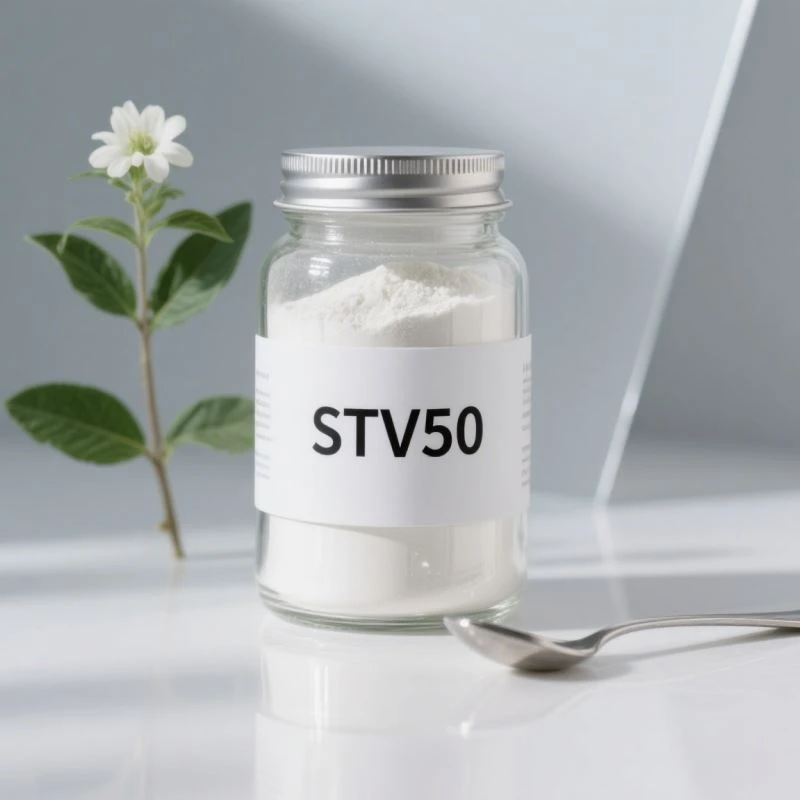
Stevioside STV50 is more concentrated in stevioside glycosides compared to Stevioside STV40. This means that it is even sweeter, usually around 300 - 400 times sweeter than sucrose. The onset of sweetness in Stevioside STV50 is also slightly faster than that of Stevioside STV40, and the after - taste may be more intense. The flavor interactions of Stevioside STV50 can be more complex, as its higher concentration can have a stronger impact on other flavors in a product.
Stevioside (STV) 70, with an even higher purity, is extremely sweet, up to 400 - 500 times sweeter than sucrose. The after - taste of Stevioside (STV) 70 can be quite pronounced, and it may require more careful formulation to balance with other flavors. In terms of mouthfeel, all three products have a relatively thin mouthfeel compared to sugar, but the differences between them are more in the degree of flavor intensity and after - taste characteristics.
Applications in the Food and Beverage Industry
The unique sensory profile of Stevioside STV40 makes it suitable for a wide range of applications in the food and beverage industry. In the beverage sector, it is commonly used in diet sodas, sports drinks, and fruit juices. Its high sweetness allows for the creation of low - calorie or zero - calorie beverages that still taste sweet. The flavor interactions can be harnessed to create unique and refreshing flavor combinations.

In the food industry, Stevioside STV40 can be used in baked goods, confectionery, and dairy products. In baked goods, it can reduce the sugar content while still providing a sweet flavor. However, due to its different mouthfeel compared to sugar, some adjustments may be needed in the baking process. For example, additional moisture - retaining agents may be required to prevent the baked goods from becoming too dry. In confectionery, it can be used in candies and chewing gums to provide a sweet taste with reduced calorie content.
Conclusion
The sensory profile of Stevioside STV40 is a complex and multi - faceted one. Its high sweetness, unique flavor interactions, and distinct mouthfeel and after - taste offer both opportunities and challenges for food and beverage manufacturers. While it may take some time for consumers to fully embrace its differences from sugar, the benefits in terms of cost - savings and low - calorie options are significant.
If you are a food or beverage manufacturer looking to explore the potential of Stevioside STV40 in your products, I encourage you to reach out for a detailed discussion. We can work together to understand your specific needs and formulate products that make the most of the unique sensory profile of Stevioside STV40. Whether you are aiming to create a new low - calorie product or looking to optimize an existing formulation, we are here to assist you.
References
- Kinghorn, A. D., & Soejarto, D. D. (Eds.). (1991). Stevia: The genus Stevia. CRC Press.
- Geuns, J. M. C. (2003). Stevioside: properties, extraction, applications, and safety. Phytochemistry Reviews, 2(4), 401 - 413.
- Prakash, I., DuBois, G. E., Clos, J. F., & Brannan, J. D. (2008). Stevia rebaudiana Bertoni, source of a high - potency natural sweetener: A comprehensive review. Critical Reviews in Food Science and Nutrition, 48(9), 981 - 993.


