


Stevioside STV60 is a well - known natural sweetener that has gained significant popularity in the food and beverage industry. As a supplier of Stevioside STV60, I am often asked about its chemical structure. In this blog post, I will delve into the details of the chemical structure of Stevioside STV60, its properties, and its applications.
The Basics of Stevioside
Stevioside is a glycoside extracted from the leaves of the Stevia rebaudiana plant. This plant, native to South America, has been used for centuries by the indigenous people as a sweetening agent. Stevioside is one of the main sweet - tasting compounds found in the stevia plant, along with other steviol glycosides such as rebaudioside A, rebaudioside C, and dulcoside A.
Chemical Structure of Stevioside
The chemical formula of stevioside is (C_{38}H_{60}O_{18}). It is a diterpene glycoside, which means it is composed of a diterpene aglycone (steviol) and sugar moieties. The basic structure of stevioside consists of a steviol backbone, which is a diterpene alcohol. The steviol molecule has a characteristic four - ring structure, similar to other diterpenes.
The steviol backbone has two hydroxyl groups ((-OH)) at specific positions. One hydroxyl group is located at the C - 13 position, and the other is at the C - 19 position. These hydroxyl groups are crucial as they are the sites where the sugar moieties are attached through glycosidic bonds.
In stevioside, the sugar moieties are composed of three glucose units. Two glucose units are linked to the C - 13 hydroxyl group of the steviol backbone, forming a disaccharide chain. The third glucose unit is attached to the C - 19 hydroxyl group of the steviol. The glycosidic linkages between the steviol and the glucose units are (\beta) - glycosidic bonds, which are important for the stability and biological activity of the molecule.
The specific arrangement of the sugar units and the steviol backbone gives stevioside its unique sweet taste. The sweet taste of stevioside is estimated to be about 200 - 300 times sweeter than sucrose (table sugar) on a weight - for - weight basis.
Stevioside STV60
Stevioside STV60 refers to a stevioside product with a purity of 60%. This means that in a given sample of Stevioside STV60, 60% of the total mass is stevioside, and the remaining 40% may consist of other steviol glycosides, impurities, or excipients.
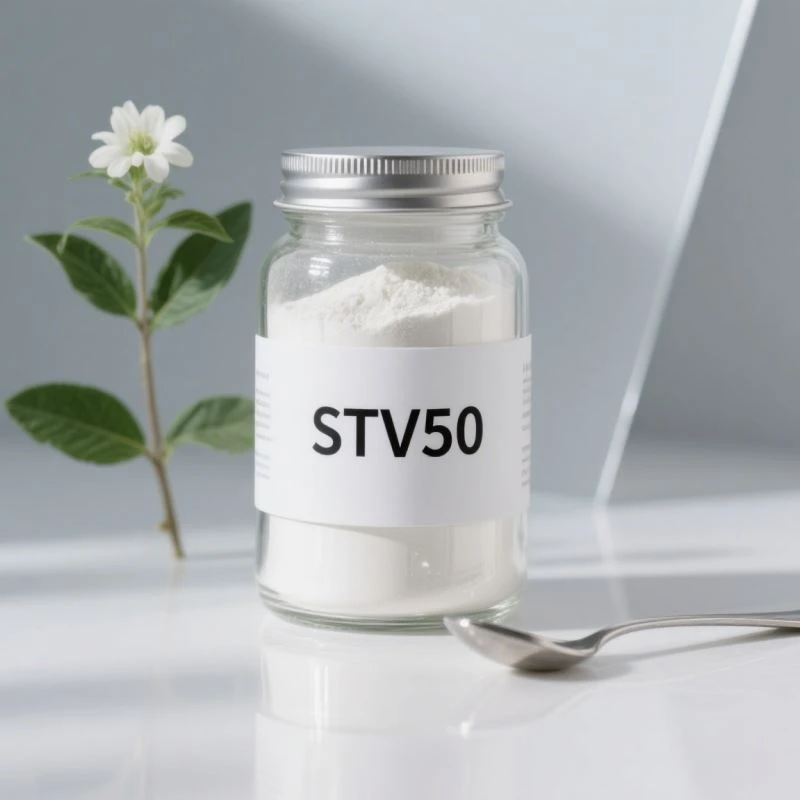
Compared to other stevioside products such as Stevioside STV40, Stevioside STV50, and Stevioside STV80, Stevioside STV60 offers a balance between purity and cost - effectiveness. The lower - purity products like STV40 and STV50 may contain more impurities and other steviol glycosides, which can affect the taste profile. On the other hand, STV80 is more pure but may be more expensive.
Properties of Stevioside STV60
- Sweetness: As mentioned earlier, stevioside is extremely sweet. Stevioside STV60, with its 60% stevioside content, still retains a high level of sweetness. It can be used as a sugar substitute in various food and beverage products, providing a sweet taste with significantly fewer calories compared to sucrose.
- Solubility: Stevioside STV60 is soluble in water and some organic solvents. Its solubility in water allows it to be easily incorporated into aqueous food and beverage systems.
- Stability: It is relatively stable under normal storage conditions. However, like other glycosides, it can be hydrolyzed under acidic or basic conditions, which may break the glycosidic bonds and release the steviol and sugar units.
Applications of Stevioside STV60
- Food and Beverage Industry: Stevioside STV60 is widely used in the food and beverage industry as a natural sweetener. It can be used in soft drinks, juices, dairy products, baked goods, and confectionery. Its high sweetness intensity allows for the use of small amounts to achieve the desired level of sweetness, which can reduce the calorie content of the products.
- Pharmaceutical Industry: In the pharmaceutical industry, stevioside STV60 can be used as a sweetening agent in oral medications, especially for patients who need to control their sugar intake, such as diabetics.
- Cosmetics Industry: It can also be used in cosmetics, for example, in lip balms or mouthwashes, to provide a pleasant sweet taste.
Why Choose Our Stevioside STV60
As a supplier of Stevioside STV60, we take pride in offering high - quality products. Our stevioside STV60 is extracted from carefully selected Stevia rebaudiana plants using advanced extraction and purification techniques. This ensures that our product has a consistent quality and a well - defined chemical structure.
We also provide excellent customer service and technical support. Whether you have questions about the chemical structure, applications, or storage of Stevioside STV60, our team of experts is ready to assist you.
If you are interested in purchasing Stevioside STV60 for your business, we encourage you to contact us for a detailed discussion. We can provide samples for you to test the product's quality and performance in your specific applications. We look forward to establishing a long - term business relationship with you.

References
- Kinghorn, A. D., & Soejarto, D. D. (1985). Stevioside and related sweet diterpene glycosides. Economic Botany, 39(2), 117 - 124.
- Geuns, J. M. C. (2003). Stevia rebaudiana (Bertoni), source of a high - potency natural sweetener: A comprehensive review. Phytochemistry Reviews, 2(4), 305 - 332.
- Brusick, D., & Meyers, M. (2009). A review of the safety of stevia (Stevia rebaudiana Bertoni) extracts and steviol glycosides. Regulatory Toxicology and Pharmacology, 54(3), 326 - 339.


