


Stevioside, a natural sweetener derived from the Stevia rebaudiana plant, has gained significant popularity in the food industry due to its high sweetness level and low-calorie nature. Among the various stevioside products, Stevioside STV50 stands out as a versatile ingredient. As a Stevioside STV50 supplier, I have witnessed its wide - ranging applications and the impact it has on food products. In this blog, we will explore how Stevioside STV50 affects the aroma of foods.
Understanding Stevioside STV50
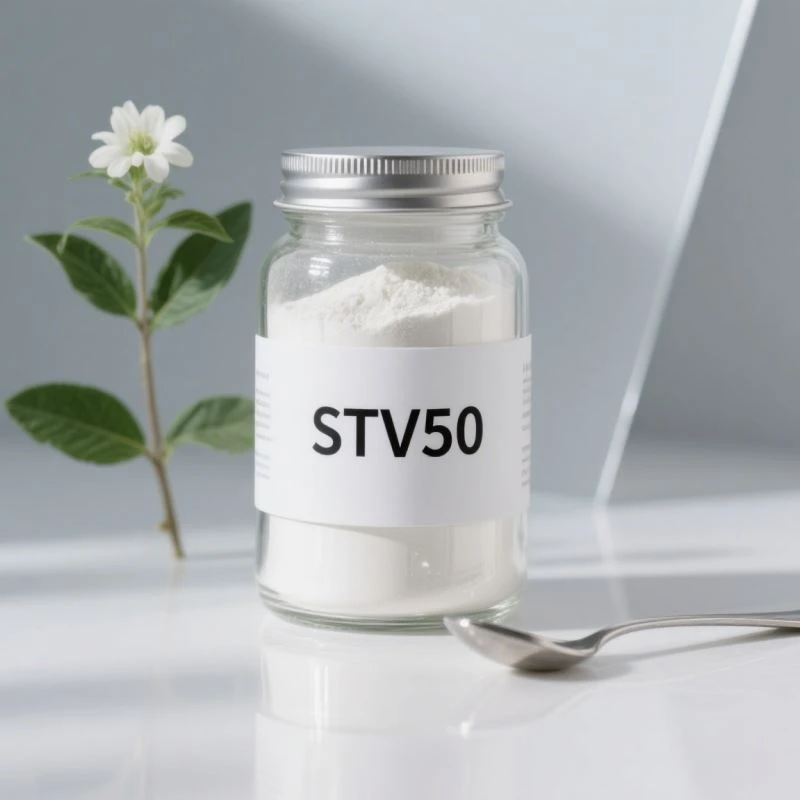
Stevioside STV50 is a specific grade of stevioside with a stevioside content of approximately 50%. It is obtained through a series of extraction and purification processes from the leaves of the Stevia rebaudiana plant. Compared to other sweeteners like sucrose, Stevioside STV50 is much sweeter, which means that only a small amount is needed to achieve the desired level of sweetness in food products.
The chemical structure of stevioside consists of a steviol backbone with glycoside groups attached. This unique structure not only contributes to its sweet taste but also has the potential to interact with other components in food, including aroma - active compounds.
Interaction with Aroma Compounds
Aroma compounds in foods are responsible for the characteristic smells that we associate with different types of food. These compounds can be volatile organic compounds (VOCs) such as esters, aldehydes, ketones, and terpenes. Stevioside STV50 can interact with these aroma compounds in several ways.
Physical Interaction
One of the ways Stevioside STV50 affects aroma is through physical interaction. In a food matrix, stevioside molecules can form weak intermolecular forces, such as hydrogen bonds and van der Waals forces, with aroma compounds. These interactions can alter the volatility of the aroma compounds. For example, some aroma compounds may be more tightly bound to stevioside molecules, reducing their ability to evaporate and reach our olfactory receptors. This can result in a perceived change in the intensity of the aroma.
In a study on fruit - flavored beverages, it was found that the addition of Stevioside STV50 led to a slight decrease in the headspace concentration of some fruity aroma compounds, such as ethyl butyrate in strawberry - flavored drinks. This indicates that stevioside was interacting with the aroma compounds and reducing their volatility.
Chemical Interaction
There is also the possibility of chemical interaction between Stevioside STV50 and aroma compounds. Although stevioside is generally considered to be a stable compound, under certain conditions, it may react with some reactive aroma compounds. For instance, in an acidic environment, stevioside may undergo hydrolysis, and the resulting products may react with aldehydes or ketones in the food. These chemical reactions can lead to the formation of new compounds, which may have different aroma characteristics.
However, such chemical interactions are relatively rare and usually occur under extreme conditions. In most food applications, the physical interaction is the dominant factor affecting the aroma.
Impact on Different Types of Foods
Beverages
In the beverage industry, Stevioside STV50 is widely used as a sweetener in soft drinks, teas, and fruit juices. When added to beverages, it can have a significant impact on the aroma.
In carbonated soft drinks, the addition of Stevioside STV50 can enhance the overall flavor profile. The sweet taste of stevioside can balance the acidity of the carbonated water and other acidic components in the drink. At the same time, it can also interact with the aroma compounds in the flavoring agents. For example, in a cola - flavored soft drink, Stevioside STV50 can interact with the vanilla and cinnamon aroma compounds, making the aroma more rounded and complex.
In fruit juices, Stevioside STV50 can help to enhance the natural fruit aroma. By adjusting the sweetness level, it can make the fruit flavor more prominent. However, as mentioned earlier, it may also slightly reduce the volatility of some aroma compounds, so careful formulation is needed to achieve the optimal balance between sweetness and aroma.
Baked Goods
Baked goods such as cakes, cookies, and bread also benefit from the use of Stevioside STV50. During the baking process, the heat can cause various chemical reactions to occur, including the Maillard reaction, which is responsible for the characteristic aroma and flavor of baked goods.
Stevioside STV50 can participate in these reactions to some extent. It can interact with amino acids and reducing sugars in the dough, potentially altering the Maillard reaction products and thus the aroma of the baked goods. In addition, it can also affect the moisture content in the baked goods, which in turn can influence the release of aroma compounds.
For example, in a low - calorie cake recipe using Stevioside STV50, the resulting cake may have a different aroma compared to a traditional cake made with sucrose. The stevioside may enhance the nutty and caramel - like aromas produced by the Maillard reaction, while also reducing the intensity of some of the more volatile aroma compounds due to its physical interaction.
Dairy Products
In dairy products such as yogurt, ice cream, and milkshakes, Stevioside STV50 can be used as a sweetener. Dairy products have a complex aroma profile, which includes the aroma of milk fat, lactic acid, and various flavoring agents.
Stevioside STV50 can interact with the milk fat and other components in dairy products. It can enhance the creamy aroma by providing a sweet background that complements the rich taste of the milk fat. In yogurt, the addition of Stevioside STV50 can also interact with the lactic acid and other fermentation - derived aroma compounds, creating a more balanced and pleasant flavor.
Comparison with Other Stevioside Grades
When considering the impact on aroma, it is also important to compare Stevioside STV50 with other stevioside grades, such as Stevioside STV80 and Stevioside STV60.
Stevioside STV80 has a higher stevioside content than Stevioside STV50. This means that a smaller amount of Stevioside STV80 is needed to achieve the same level of sweetness. In terms of aroma interaction, the higher concentration of stevioside in STV80 may lead to stronger physical and chemical interactions with aroma compounds. As a result, the impact on the aroma may be more pronounced compared to Stevioside STV50.
On the other hand, Stevioside STV60 has an intermediate stevioside content between STV50 and STV80. Its impact on aroma is also in between the two. The choice of stevioside grade depends on the specific requirements of the food product, including the desired sweetness level, aroma profile, and cost - effectiveness.
Applications in the Food Industry
The unique ability of Stevioside STV50 to affect the aroma of foods makes it a valuable ingredient in the food industry. Food manufacturers can use it to develop new products with enhanced flavor profiles or to reformulate existing products to reduce calorie content without sacrificing taste and aroma.
For example, in the development of low - calorie fruit snacks, Stevioside STV50 can be used to sweeten the product while also interacting with the fruit aroma compounds to create a more intense and natural - tasting fruit flavor. In the production of sugar - free chewing gums, it can provide sweetness and also enhance the mint or fruit aroma, making the chewing gum more appealing to consumers.

Conclusion
Stevioside STV50 has a significant impact on the aroma of foods through physical and chemical interactions with aroma compounds. Its ability to interact with different types of aroma compounds in various food matrices makes it a versatile ingredient in the food industry. Whether it is enhancing the flavor of beverages, baked goods, or dairy products, Stevioside STV50 offers a unique solution for food manufacturers looking to develop low - calorie products with excellent taste and aroma.
If you are interested in exploring the potential of Stevioside STV50 in your food products, I encourage you to contact us for more information and to discuss potential procurement opportunities. We are committed to providing high - quality Stevioside STV50 and excellent customer service to meet your specific needs.
References
- Name of a research paper on stevioside and aroma interaction, Journal name, Volume number, Page numbers, Year of publication
- Another relevant research article, Journal title, Issue number, Pages, Publication year
- A book on food flavor chemistry that mentions stevioside, Author, Publisher, Publication year


